What is this episode about?
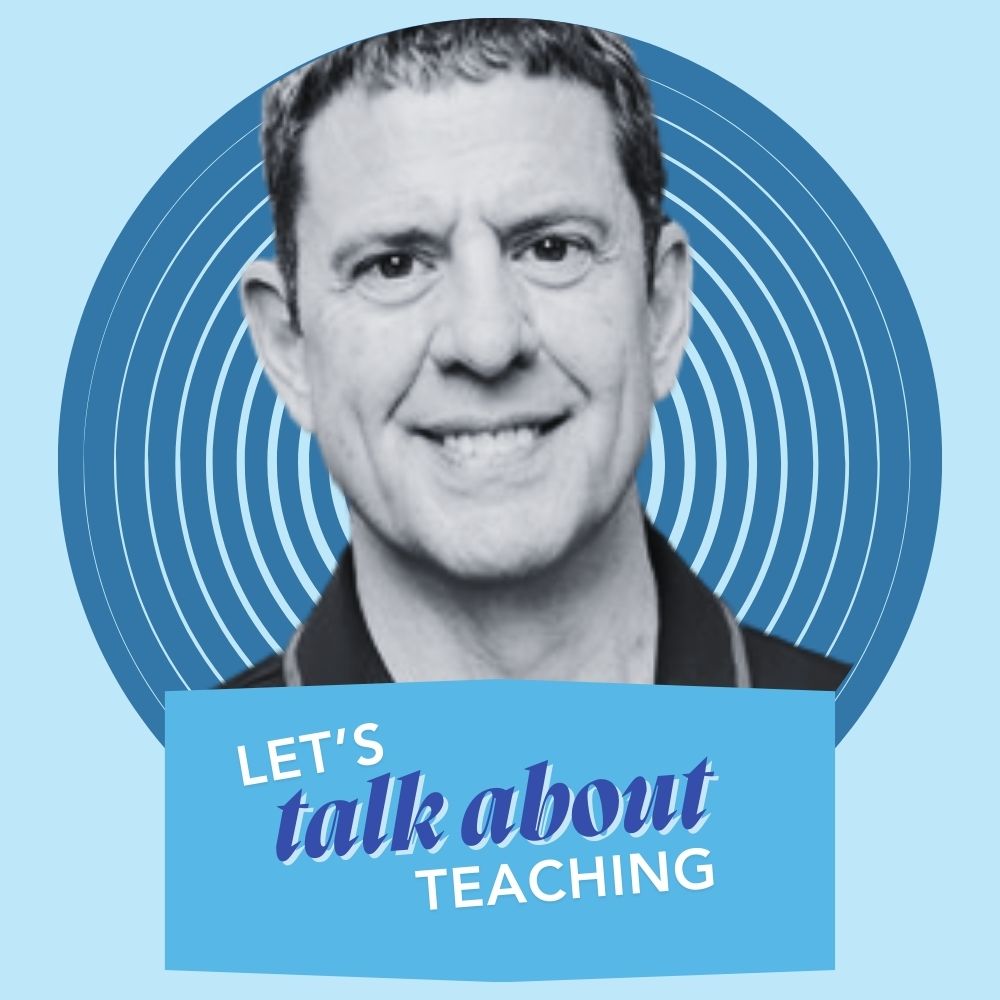
In this episode, Inclusive and Strength-Based Teaching Strategies, Dr. Bruce Ravelli shares his philosophy and practices for fostering a student-centered, inclusive learning environment. He begins by introducing the courses he teaches—Introduction to Sociology for first-year students and a community-engaged course for fourth-year students—both of which he is particularly passionate about. He describes the course setups and general assessment designs (2:00), then delves into the philosophy behind his approach, explaining how and why he strives to create a flexible and supportive environment for all students (7:44). Later, he specifically discusses how he offers students choice in the format of their assessments and how they demonstrate their learning (11:00). The episode concludes with Bruce reflecting on how he sparks student interest and excitement in sociology (14:50).
Meet our guest
Dr. Bruce Ravelli has been a Teaching Professor in UVic’s Sociology department since 2013 and was a Professor at Mount Royal University before that. He is a co-author of one of the most popular textbooks in Canada in his field called “Exploring Sociology: A Canadian Perspective” now in its 6th Edition. He was the inaugural winner of the Lorne Tepperman award from the Canadian Sociological Association for Outstanding Contribution to Teaching in 2021. He also won the international MERLOT award for his co-development of a free online tool, called “Toofast”, that has helped over 15,000 teachers around the world and has processed more than a half-million assessments. He is also the creator of “MakingSociologyMatter.com”, a website dedicated to connecting students, colleagues, and the public to examples of sociology in action, “AppliedSociology.org” that connects applied sociologists, and is co-creator of “StrangersByDesign.org”, a website bringing together perspectives on and experiences with equity, diversity and inclusion as seen by different members of the campus community. Dr. Ravelli has a specific passion for working with large groups of first-year students in the department’s Introduction to Sociology courses, and in community-engaged learning courses where he guides fourth-year students in their work with local non-profit organizations.
Explore resources
-
Making Sociology Matter – a website dedicated to connecting students, colleagues, and the public to examples of sociology in action in our world.
-
Strangers By Design – a website bringing together perspectives on and experiences with equity, diversity and inclusion work as seen by different members of the campus community.
Transcript
Transcript – Bruce Ravelli
Sarah
Welcome to the Let’s Talk About Teaching podcast, a podcast dedicated to exploring innovative teaching practices in post-secondary education, examining the day-to-day challenges of implementing and uncovering strategies for success. We’re excited to broaden the conversation and to continue sharing stories and insights from educators that inspire reflection and growth. My name is Sarah DeDecker, and my pronouns are she/her. I am a Curriculum Developer in STEM with Learning and Teaching Innovation, also known as LTI at the University of Victoria.
Jeremy
And I am your co-host Jeremy Wintringer, and my pronouns are he/him. I’ve recently joined LTI as a Curriculum Developer focusing on large class pedagogy. Before we begin, we would like to acknowledge and show respect to Lək̓ʷəŋən (Songhees and Esquimalt) Peoples on whose territory the university stands, and the Lək̓ʷəŋən and W̱SÁNEĆ Peoples whose historical relationships with the land continue to this day.
Sarah
In this episode, ‘Inclusive and Strength-based Teaching Strategies’, we explore innovative strategies that are grounded in strength-based, student-based learning that expand inclusivity within large classroom settings. We are joined by Dr. Bruce Ravelli, who has been a teaching professor at UVic’s Sociology department since 2013. Bruce was the winner of the Lorne Tepperman Award for Outstanding Contribution to Teaching in 2021 and has a specific passion for working with large groups of students in the department’s Introduction to Sociology courses and in community engaged learning courses where he guides fourth year students in their work with local nonprofit organizations.
Transition music
Sarah
Hello, Bruce, welcome to the podcast.
Bruce
Hi there, welcome to be here.
Sarah
Thank you for joining us. As we start our conversation today, could you share a little bit about yourself and the courses that you teach? We would be interested in knowing about the specific topics, number of students, your year level, and the types of assessments you use.
Bruce
Sure, my pleasure. So, I teach, I’ve been teaching for ages. I’ll let people that are listening think about the actual number of years or decades, but I’ve been teaching sociology for a very long time, started after I graduated from UVic actually. And the courses I’ve really developed and the ones I’m most passionate about are the first year introduction to sociology classes that I spend most of my time focusing on and most of my writing on, as well as a fourth year community engaged course on applied sociology, and that’s a full year course, 439 A and B, that students actually work with community partners that we partner with in the community, and they work with the same community partner over an eight month period. So, I see that there’s some interest in, in some of the assessments that I use for students in those two courses. So, if I could just talk a little bit briefly about what I do in the first-year class, I’m thinking about how to draw students into the discipline. My classes generally are big, anywhere from 200 to 325, I think is the largest class. So, it’s difficult to not have it be performative when you’re speaking to that many students, but my audience has always been and still is today, that student that’s sitting there in that classroom for the first time, that feels nervous and apprehensive, not knowing what they’re doing there, scared and alone, and I want to use my course to connect that student to sociology in ways that I think are relevant to everyone. So, I see the 325 in front of me. I do have a performative nature in my teaching, but I’m always thinking that that person only sees one person at the front of the class, and I really try to make connections with them.
My assessments, though, when I’m dealing with 600 students, you know, have to deal with the reality of the work I’ve got. Students do three midterm exams, and I believe in incremental learning. So, the first midterms were 10%, second is 20%, and their final exams were 30%. Those are in class written midterms, where I provide students questions in advance of those. So, they’ll get the four or the two essay questions at least a week to ten days before the exam, so they can prepare. The day of the test, I will select one or two from that group of two or four that students have to write on. And many people will say, you know, that’s a lot of pressure put on students. I appreciate that but I believe strongly there is a benefit for a student having to study where they know the question that I’m interested in. So those are the midterms. There’s a video assignment that I use that is for 10%. And again, I will have the students to select their choice of four videos that ask one question, and that lets a student to be able to, you know, maybe they’re interested in racialization or in poverty, and I’ll try to have four really compelling videos that they can listen to and watch on their own time, and then submit a submission online on their choice of the four. And the two final parts of the class are they have to do multiple choice questions from the textbook. And I mean, I’m not a big fan of multiple choice. However, I want students to be able to open their textbook in a time and a place they want to open it. They can search the book to find the answer and then insert it into the multiple-choice question. Who wouldn’t do that? I want all my students to get 100% on these multiple-choice questions. Why wouldn’t they? The purpose isn’t to test their knowledge of sociology; the purpose of the multiple-choice textbook questions is to get them to open the book. And whenever I can have a student have those touch points in sociology, wherever it may occur, reading their textbook, listening to their textbook, having a conversation with a friend, that’s what I’m really trying to get for in that class. And final is just 10% for attending tutorials. We’re not going to make you submit something that is meaningless, we just want you to be there. We offer eight tutorial sessions over the semester. If you show up for six, you get the full 10%, and then we use incremental up to that. So, you don’t have to attend one, you can be sick, etc. but we want to give students credit for showing up for that one hour.
In the community engaged course, that’s something completely different. I get to have those twenty students leave Ring Road and go out and work in the community with partners they’ve chosen and that I work with, to actually do something with these community partners that the community partner wouldn’t otherwise be able to do. And it can be having their websites built, it can be having a grant application drafted, it can be about building anything that benefits, a survey can have that. And the purpose of that course is really to get students to build some confidence that they have learned more than that they think they’ve learned throughout their sociology degree. When they’re out working with partners, they may design a survey, they may help the community partner host their AGM, whatever makes that community partner better. I teach the large first year class, students go away for three or four years, and then I see them back in that seminar class, and it really reinforces to me. Uh, the privilege I have to see a student at the beginning of their journey and then help them usher and celebrate the journey at the end of their degree.
Jeremy
That was a lot of wonderful information to start with. You know, I’m hearing you talk about the large introductory courses with the 200 or 300 students, and I’m curious to hear what your view or your philosophy is behind the inclusive environment you try to foster within that course. For example, you talk a little bit about giving students a little bit of room to choose the topics that they want to do some work on and I’m curious beyond that. You talk about wanting the student to feel visible and to feel like, you know, they stand out to you along with all the other hundreds of students. So how is a student’s own life experience or their community or some other aspect of themselves reflected in how you teach?
Bruce
That’s a great question. I try to think about inclusion from the place where I am, and this is not something I was thinking about twenty years ago or ten years ago. But when a student enters my sociology class in their first year, what do they see? They’re in a big lecture hall and this older white, cishet male standing at the front of the class is going to be their instructor, their professor for sociology for that year. And what I’ve tried to think about is I am who I’ve been socialized to be. I assume the role of the professor. I’m responsible for that space, but what I try to do to make it inclusive, and I’ll own it, I’m successful, I believe, for many students, but not all. I try, but I can’t succeed everywhere. And what I’ve learned to do is I am who I am, and I try to get students to learn to see the world that I have been taught to see as an old white, cishet male, as a way that they can start to think about themselves differently.
And the way I try to do that is that I tell stories that include myself. And I don’t want somebody listening to think, you know, intro sociology is life according to Bruce. Every story I tell in that class is to help my students see and understand sociology. And if they hear about my struggle when I was young, growing up in a smaller town, or when I had struggles with school or authority, what I’m trying to do is to have them learn, if I can say that at the front of the class, I’m giving them permission to explore their own socially constructed world, and the way that my socially constructed world has made me conscious of my environment. So, when I teach and I try to help students see the world that I’ve been taught to see, I hope they can start to see the world they’ve been taught to see. Everything we talk about in sociology is about you. There is no topic we talk about that doesn’t resonate with every student in that class. So, my inclusiveness and my attempt to give student voice is to give them choice, but to help them see that I’m willing to show you my life, what I’ve done right, and what I think I could work better on, so they can see themselves in a different perspective.
Sarah
Thank you for sharing all of this insight so far and I think you’ve kind of touched on this, but what are some practices that you’ve integrated into your teaching that you feel expand choice and flexibility? You had mentioned in regard to choice around the videos that the students get to select and you also spoke around the flexibility they have in answering those textbook multiple-choice questions, but is there anything you’d like to expand on in regard to that?
Bruce
Sure. So, I’ve got to temper my comments and that I don’t want to create the vision that 600 students can be very creative in the path we have to assess them to get the grades in on time. So, I’ll be as flexible as I can within the reality that I have an obligation and responsibility to get grades submitted on time for everyone. Within that flexibility, I’m really clear to students to say, I’ve designed this course over decades to have it a certain way that I think makes sense and works for 99% of the students. They know what is coming, when it’s coming, and what it’s about. And that for 600 students, I think, does meet the job that we’re all there to do. But I’ve always offered and always have offered every student that I teach what I call an option two. And an option two is, if you don’t feel midterms, the video assignment or whatever, does not represent your command of sociology, you can come and pitch me an idea. And I have had, I would say, half a dozen students every semester that want to do oral exams. I have to be conscious of my time that if I had 100 students in that class wanting to do oral exams, because I have to manage these myself, I couldn’t manage that, but I keep the option two open for everyone. I’ve had students write a journalism article about if they interviewed Karl Marx in 100 years, what he would be saying about where the world went. And I’ve had students do spoken word poems about concepts that we agree to in advance. So, the option two is a high-pressure situation for that first-year student, but I leave it open. I try to give them examples, and I post some on my website. The flexibility and listening to students’ individuality and all that is much more in tune with that fourth-year seminar where I’ve got twenty students.
And then the projects that they’re working on, I do not define, because I don’t know if that community group is going to want a survey or a website. So, the assessments in that course are much more based on the student’s reflection. And we talk a lot about students thinking about their own growth as sociologists, but I’ll tell you in that fourth-year seminar, these students are really starting to think about thinking. And they’re starting to think about their sociology, not our sociology, and to have a student think about where they began in intro and where they are in fourth year, there’s a lot of autonomy and a lot of individuality in what they write. Last thing I’ll say about those reflections is we can tell you what a reflection is. I can give you an example of reflection I wrote, but a really good reflection is when you don’t worry about me, the teacher, grading it. When you say what you need and want to say, that’s where the best reflections live, and it takes students three, four times working through these reflections, and I’ll give them prompts in the assignment, but it takes some time to unlearn what we’ve taught you. And to make your sociology, that is your sociology, not the sociology you’ve been taught. And that’s where I think their careers really take off.
Jeremy
So, I want to shift gears a little bit. We’ve talked about flexibility and the design of the assessments, and you’ve shared a lot about what you make available to students to put them in a position to succeed. So, I’m a little curious about engagement and about preparation separate from that. What do you do on day one to get them interested, to get them focused? What do you do, you know, a week before the exam to keep their, you know, spirits going, and in particular, how do you get them excited about sociology?
Bruce
I can’t not connect with my students about sociology, because I absolutely and conclusively believe in my soul sociology is the vehicle for understanding where we are today, where we came from, and where we should be going. And I never go into a class where I don’t feel that about every freaking lecture that I give. People say I’ve been teaching intro for thirty, forty years, I can’t remember what it is, and like how I could say that lecture over and over again. I always remember, but it’s that student’s first time. And that’s the person I want to kind of influence with a different way of seeing the world, not Bruce’s way, but a different way of seeing the world that you’ve been taught to see. And my video assignments, there’s four up there. Pick one and do your assignment, but I know students probably watch all four, to pick the one they really want to write on. I have then had them look at three things they wouldn’t otherwise have looked at, and they learned a little bit more sociology. So, whether they’re listening to the textbook on the bus or whatever, those contact points that I can have them think about that sociology when they’re talking to their friend, their parents. You know, on a retreat, a vacation, those are the points that I think teach sociology outside of the class that I’m always trying to connect with. Sociology happens when you’re walking to class, and when you’re coming out of class, not necessarily always inside the class. Sociology is everywhere all the time and always will be.
So, I think over time, and my love for what I do, that engages people and that doesn’t mean they all become sociologists, but that does mean that when they choose psychology or philosophy, they’re doing it, and they realize it’s really about the discipline that they love. It doesn’t have to be the good instructor that tells great stories. You have to love the discipline you choose, because good teachers come and go, hard courses come and go, but you’ve got to love the discipline. So, I think that engagement over time for me in intro, it’s kind of an alien thing cause there’s a lot of students in that class, but I do love what I do, and I do believe it changes lives. Doesn’t change everyone’s lives, but if it changes some, I feel like we’ve all done good work.
Sarah
Thank you so much, Bruce for having this conversation with us today. It was very insightful to hear about your experience throughout your career and your experiences of your students and the strategies that you implement into your courses. I certainly feel very inspired after that conversation, so thank you.
Bruce
Absolutely my pleasure. I hope everyone gets a tidbit from something that I said, I’m not the master of anything, but I hope you think about you, your students, or if you’re a student about what you want your education to be, and end off by saying, always give a person the opportunity to say yes and help, because those are the moments where a person learns, asking for help is not a sign of weakness, it is a sign of strength.
Sarah
Thank you for tuning in. We hope the conversation we have shared has proven interesting and useful. Bruce has shared two additional resources with us that can be found in the podcast resource notes. He created ‘MakingSociologyMatter.com’, a website dedicated to connecting students, colleagues, and the public to examples of sociology in action in our world. And he is the co-creator of ‘StrangersByDesign.org’, a website bringing together perspectives on and experiences with equity, diversity and inclusion work as seen by different parts of the campus community. Make sure to visit our Teach Anywhere website at uvic.ca/teachanywhere, where you can learn more about teaching and learning at UVic. We will talk to you again soon.
Credits
-
Hosts: Sarah DeDecker & Jeremy Wintringer
-
Guest: Dr. Bruce Ravelli
-
Technical Production: Jiexing Hu, Sarah DeDecker & Lesley Ellis
-
Transcript Preparation: Sarah DeDecker
-
Theme music: “freesound1.wav” by freezound5 (https://freesound.org/people/freezound5/sounds/588258/) and “sonically_sound.wav” by freezound5 (https://freesound.org/people/sonically_sound/sounds/624643/). Available for use under the CC0 1.0 Public Domain Dedication at freesound.org.
Listen to other episodes
Instructor presence with Professor Jin-Sun Yoon
What is this episode about? In this episode, Professor Jin-Sun Yoon (she/they) from the School of Child and Youth Care talks about what teaching means to them (2:29) and the courses they work with (5:10). They share how they think about presence in online learning...
Time is On Your Side: A Discussion of Universal Extended Time in Assessments (Part 1 with Dr. LillAnne Jackson)
What is this episode about? In this first episode of our series, ‘Time is on Your Side’, Dr. LillAnne Jackson, shares her perspective and experience in supporting the integration of Universal Extended Time in exams. She begins by clarifying the terminology used in her...
Time is On Your Side: A Discussion of Universal Extended Time in Assessments (Part 2 with Dr. Breanna Lawrence)
What is this episode about? In this second episode of our series, ‘Time is on Your Side’, Dr. Breanna Lawrence shares her experience applying Universal Extended Time in asynchronous quizzes to support students' self-regulation and engagement in her course. She begins...